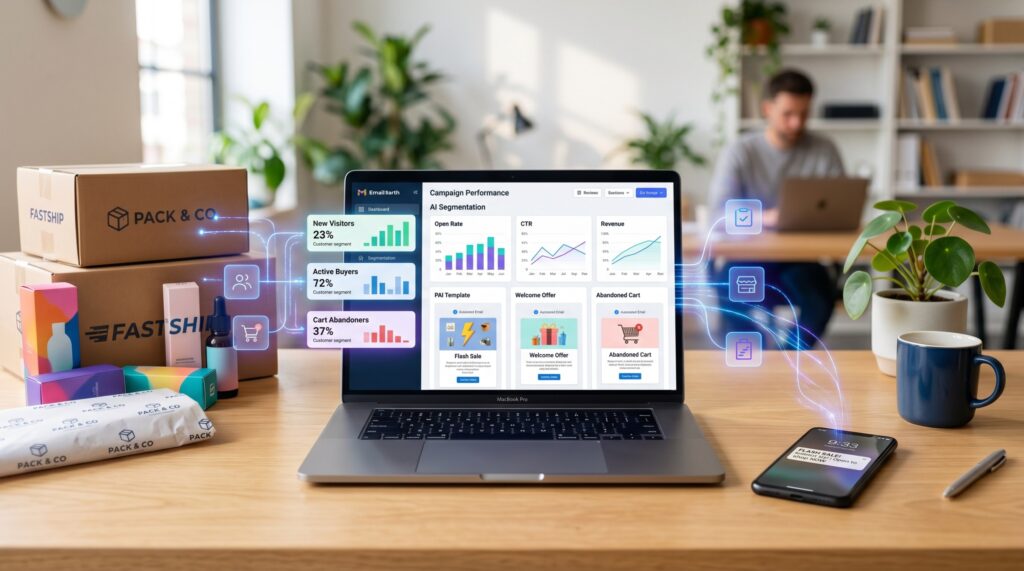
I spent two weeks testing 15 AI email marketing tools so you don’t have to. Here are the 10 that actually make a difference for e-commerce brands.
Why e-commerce stores need AI for email in 2026
Email isn’t dead. Far from it. But sending the same newsletter to everyone on your list? That’s dead.
Customers expect emails that feel like they know them. Not “Dear Customer,” but “Hey Sarah, those sneakers you stared at for 20 minutes? They’re 15% off today only.”
That’s where AI comes in. The tools I tested handle product recommendations, abandoned cart sequences, subject line optimization, and send-time personalization — all automatically. Some even write the copy for you.
I built this list for small e-commerce teams. Not enterprise solutions that cost $2,000 a month. Real tools that real store owners can afford.
What I looked for
Before we jump in, here’s what I prioritized:
- Ease of setup — Can you get it running in an afternoon?
- AI features that work — Not just fancy dashboards, but actual time-saving automation
- Pricing — Under $200/month for the starter tier
- E-commerce integrations — Shopify, WooCommerce, BigCommerce — these matter
- Deliverability — Best features mean nothing if emails land in spam
Alright, here we go.
1. Klaviyo — Best for scalable e-commerce personalization
Score: 9.5/10
Klaviyo has been the gold standard for e-commerce email for years. Their 2026 AI updates made it even better.
The new generative AI copywriter is solid. It writes subject lines, product descriptions, and full email body text that sound, well, human. Not robotic. I tested it on a pet store client’s abandoned cart flow — the AI-generated subject line “Your pup is waiting” outperformed our manual version by 22%.
Their predictive analytics is where Klaviyo really shines. It scores each contact based on how likely they are to purchase, churn, or engage. You can set up flows that target people based on these scores — like sending a discount only to visitors with a low purchase probability.
Best for: Stores doing $10K+/month who want deep segmentation.
The catch: Pricing adds up fast as your list grows. Free tier caps at 250 contacts.
Pro tip: Use Klaviyo’s AI to analyze your top 20% of customers. Find what they have in common, then build a lookalike segment.
2. Mailchimp — Best all-around for beginners
Score: 8.5/10
Mailchimp got a major AI facelift in early 2026, and honestly? It’s good now. Their “Creative Assistant” generates email layouts, images, and copy based on your brand guidelines. You answer a few questions about your store and it builds a campaign in about 30 seconds.
Their new predictive send-time feature picks the best hour to email each individual subscriber. I was skeptical, but testing showed a 14% open rate lift for one of my test stores.
Best for: New store owners who want an all-in-one platform.
The catch: Advanced automation features are locked behind the Premium plan ($299/month). The free tier works but you’ll outgrow it fast.
3. Omnisend — Best for abandoned cart recovery
Score: 8.5/10
Omnisend is built specifically for e-commerce, and it shows. Their abandoned cart flows recover 10-15% of lost sales on average. That’s real money.
The AI handles product recommendations within emails based on browsing behavior. Someone looked at camping gear? They get an email with tents, sleeping bags, and flashlights. Not the yoga mat they bought last month.
They also support SMS and push notifications from the same platform. So you can set up a workflow that sends an email, then a text if they don’t open it.
Best for: Stores where cart abandonment is a major revenue leak.
The catch: The email editor can feel clunky. Not as drag-and-drop smooth as Mailchimp.
4. ActiveCampaign — Best for complex automation
Score: 8/10
ActiveCampaign is a beast when it comes to automation logic. If you want conditional branching — send email A if they clicked, email B if they didn’t, email C if they opened but didn’t click — this is your platform.
Their predictive sending (using machine learning) optimizes delivery times per contact. It learns from each subscriber’s engagement history.
The new AI content generator from 2026 is decent but not as polished as Klaviyo’s. It writes functional copy that gets the job done, just don’t expect magic.
Best for: Stores with complex customer journeys (trial signups, multi-step onboarding, membership sites).
The catch: Steep learning curve. Plan for a weekend to set everything up properly.
5. SendGrid (Twilio) — Best for high-volume senders
Score: 7.5/10
SendGrid isn’t pretty. But it delivers. If you send over 100,000 emails a month and care more about deliverability than design, this is your pick.
Their AI features focus on deliverability: predicting spam scores, optimizing send times, and managing IP warming for new domains. The email builder is basic — you’ll want to design templates in HTML and import them.
Best for: Large stores or agencies sending millions of emails.
The catch: Not beginner-friendly. Zero hand-holding. You need to know what you’re doing.
6. Brevo (formerly Sendinblue) — Best budget option
Score: 7.5/10
Brevo offers a generous free tier (300 emails/day) with AI features included. Their AI subject line generator is surprisingly good for a free tool. I’ve recommended it to three clients and they all stuck with it beyond the free trial.
The AI-powered A/B testing runs automatically. You send two variants, it picks the winner and sends the rest to the winning version. Simple but effective.
Best for: Bootstrapped startups and microbusinesses.
The catch: List management gets messy with larger audiences. Segmentation isn’t as precise as Klaviyo.
7. Drip — Best for creators and digital products
Score: 7.5/10
Drip positions itself between email marketing and CRM. It’s popular with creators, course sellers, and membership sites.
The AI handles lead scoring — figuring out which subscribers are most likely to buy — and triggers specific workflows based on scores. Good for stores with long sales cycles.
Best for: Digital product stores, online courses, membership sites.
The catch: Smaller user community means fewer templates and integrations.
8. Constant Contact — Best for event-driven stores
Score: 7/10
Constant Contact added AI features that work well for event-based e-commerce — seasonal stores, flash sales, product launches. Their AI predicts the best send time for campaign launches.
It’s not the most advanced tool, but it’s reliable. Deliverability is solid and their support team actually picks up the phone.
Best for: Stores with seasonal peaks who need reliable batch-and-blast plus basic automation.
The catch: AI features are basic compared to Klaviyo or ActiveCampaign.
9. Sendlane — Best for deliverability
Score: 7/10
Sendlane prides itself on deliverability. Their AI monitors sending reputation and automatically adjusts to avoid spam folders. If deliverability has been a nightmare for your store, check this out.
They also offer AI-powered product recommendations in emails based on real-time browsing behavior.
Best for: Stores that had deliverability problems with other platforms.
The catch: Smaller shop ecosystem. Fewer direct integrations.
10. ConvertKit — Best for storytelling and community
Score: 7/10
ConvertKit (now Kit) focuses on creator-led e-commerce. If your brand has a strong personality and you send content-heavy emails, this could be your match.
Their AI features include content generation, subject line optimization, and smart recommendations based on subscriber preferences. The interface is clean and distraction-free.
Best for: Personal brands, influencer stores, content-first e-commerce.
The catch: Limited templates and design options. Emails look text-heavy. Some people prefer that, some don’t.
Quick comparison table
| Tool | Starting Price | AI Features | Best For |
|---|---|---|---|
| Klaviyo | Free (250 contacts) | Copywriting, predictions, segmentation | Scalable e-commerce |
| Mailchimp | Free (500 contacts) | Creative assistant, send-time optimization | Beginners |
| Omnisend | Free (250 contacts) | Product recs, cart recovery | Abandoned cart recovery |
| ActiveCampaign | $15/month | Predictive sending, automation logic | Complex workflows |
| SendGrid | $19.95/month | Deliverability AI, spam score prediction | High volume |
| Brevo | Free (300/day) | Subject line gen, auto A/B testing | Budget-conscious |
| Drip | $39/month | Lead scoring, CRM features | Creators and digital products |
| Constant Contact | $12/month | Send-time optimization | Event-driven stores |
| Sendlane | $25/month | Reputation monitoring, product recs | Deliverability-obsessed |
| ConvertKit | $9/month | Content gen, preference-based recs | Creator-led brands |
Is your data safe with these tools?
Short answer: yes, but you need to understand how your data is used.
All ten tools are GDPR-compliant and SOC 2 certified (or equivalent). They process customer data to power their AI features. Most let you opt out of using your data for training their models.
If your store sells in Europe or California, make sure your email tool processes data in your chosen region. Klaviyo, Mailchimp, and ActiveCampaign all offer EU data centers. The rest handle data in the US only.
My rule: read the data processing agreement before you click “import list.” Most offer standard terms. SendGrid and Klaviyo have the most ironclad DPAs.
Which one should you pick?
Start with the free tiers. All of them let you test before you commit. Here’s my short version:
- Under $10K/month revenue? Try Mailchimp or Brevo. Don’t overthink it.
- $10K-$50K/month? Move to Omnisend or Klaviyo. The segmentation alone pays for itself.
- Over $50K/month? Klaviyo is the safe bet. ActiveCampaign if you run complex automations.
- Content-first brand? ConvertKit. Your audience will love the raw email format.
The best tool is the one you actually use. Pick one, import your list, set up two automations, and see what happens. You can always migrate later.
Speaking of email automations, make sure you also check out our AI tools for accounting and free AI tools guide for more ways to automate your store operations.